Blog ·
Synthetic user testing: what AI visitors can and can't tell you
Synthetic user testing shows a page to simulated visitors, AI models given a persona, and asks what they understood. It's good at finding words that several visitors misread the same way. It can't tell you whether real people will buy, and it's only as honest as the way the answers are checked.
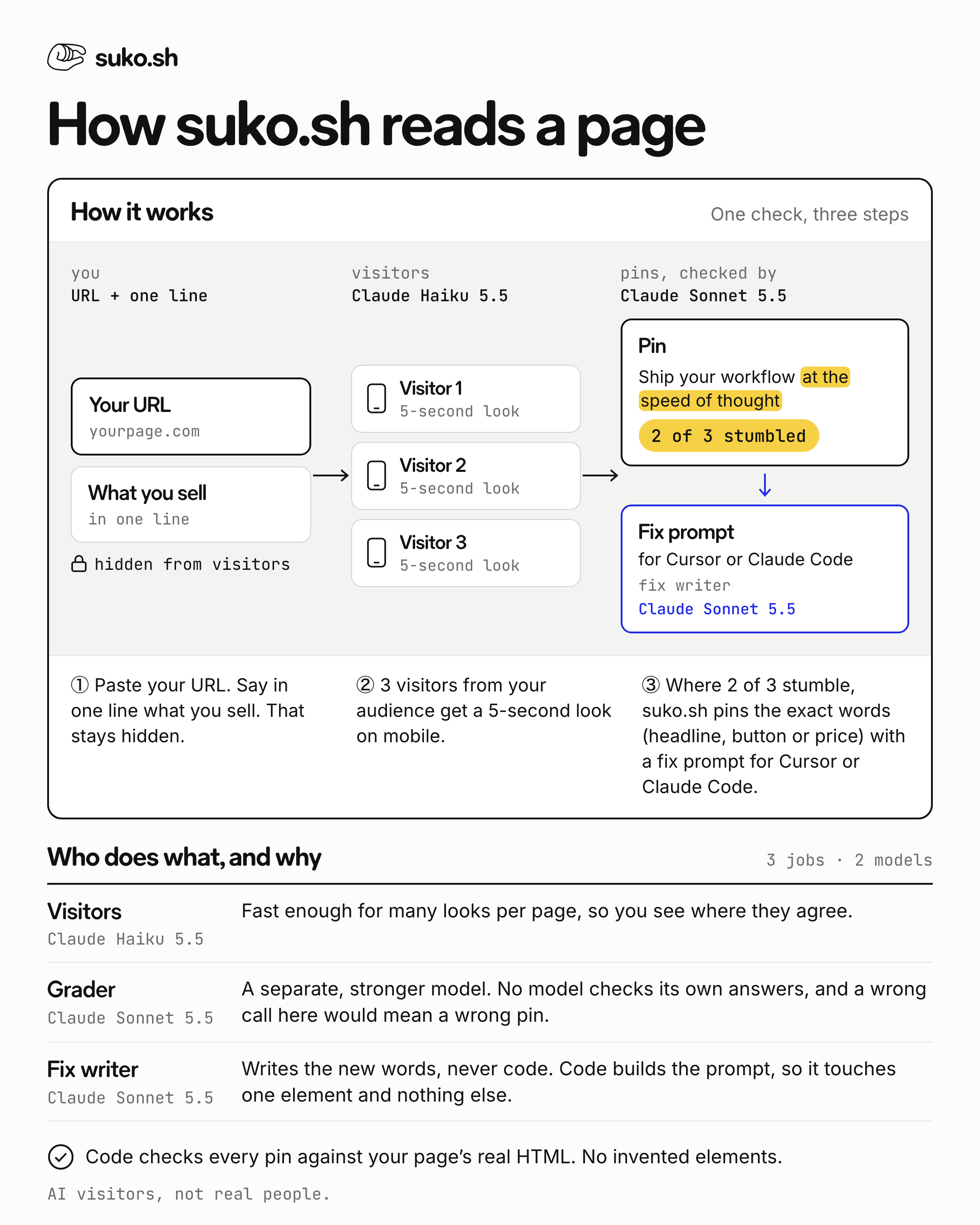
What synthetic user testing is
Synthetic user testing, sometimes called AI user testing, uses synthetic visitors instead of recruited people. A synthetic visitor is an AI model told who it is, say “someone in Singapore who takes the bus to work every day”, and then shown your page. It looks, then answers plain questions in its own words: what is this, who is it for, what does it cost, what does the main button do.
It isn’t a person. It has no budget, no hurry and no bad day, and it reads differently from a human. What it does share with a first-time visitor is that it knows nothing about your product except what’s on the screen. That’s the part worth testing, and the part you can’t test on yourself: you already know what your page means.
What synthetic user testing can tell you
- Whether your words come across. You say in one line what you sell. If the visitors say something else, the gap is in the words on the page.
- Where several visitors trip on the same words. One visitor misreading a button is noise. Two of three misreading the same button is worth reading closely.
- What they actually said. The quotes matter more than the count. “Probably goes to the app store” tells you what to change. “2 of 3” only tells you where to look.
What synthetic users can’t tell you
- Whether real people will sign up or buy. The visitors are simulated. A clearer page is easier to understand, and that’s all a synthetic test can show.
- Whether a fix works, until the fix is tested. A suggested rewrite is a guess until visitors read the new words and say them back.
- Much about trust. AI visitors doubt most claims they can’t check, so a trust doubt is worth weighing, not a finding that the claim is false.
Why one model shouldn’t do every job
The simple setup is one model that looks at the page, answers, checks its own answers and writes the fix. It’s cheap to build and easy to fool, since a model reviewing its own work tends to agree with itself. We split the work into three jobs:
- Visitors: Claude Haiku 5.5. It’s fast enough for many looks per page, so you see where the visitors agree, not just what one of them said.
- Grader: Claude Sonnet 5.5. It’s a separate, stronger model. No model checks its own answers, and a wrong call at this step would mean a wrong pin. Of the three jobs, this is where a mistake costs the most.
- Fix writer: Claude Sonnet 5.5. It writes the new words, never code. Code builds the fix prompt for Cursor or Claude Code from those words, so the change touches one element and nothing else.
Then code checks every pin against the page’s real HTML. A model can describe a button that isn’t there. Code can’t.
What it looked like on our own page
On 25 Nov 2026 we checked BAAS, our own landing page for a Singapore bus app, with visitors who take the bus to work or school every day. The check’s log shows the split: the visitors ran on Claude Haiku 5.5, and the grader and fix writer on Claude Sonnet 5.5.
2 of 3 AI visitors couldn’t tell where the main button, “Follow along”, leads. In their words: “Probably goes to the app store” and “Can’t tell; probably goes to the app store”.
The fix writer suggested “Follow the launch”. This check didn’t test it. An earlier check of the same page did, and the new wording made no clear change: we wrote that one up. That’s why we keep found, suggested and tested apart. The stumble showed up both times. The first rewrite wasn’t the answer.
How to read synthetic test results
- Look for agreement, not one voice. A pin needs two or more visitors stumbling on the same words.
- Read the quotes before the numbers. They tell you what visitors thought the words meant.
- Treat every fix as a suggestion until it’s tested. Run the check again on the new words.
- Move to real visitors when you have them. Once enough people reach your page, an A/B test answers what a synthetic test can’t. How to test without one covers the step before.
suko.sh runs this split on any landing page, and the method page has the details.
How a check works, and what it can’t tell you: How it works.
Paste your URL. The check is free.
Three AI visitors from your audience take a five-second first look. You see the exact words that confused them.